Posts

Showing posts with the label Central Visayas

Serafin Miguel Diaz Teves III - Visual Artist,Heritage Advocate and Social Historian

Image
  Serafin Miguel Diaz Teves III, Nito to friends, was a nurse, visual artist,Sugar Planter, Cultural & Heritage Advocate, Social Historian of Bais City and vocal advocate for local cultural preservation. He was born on 25 August 1956 to then Former Bais City Vice Mayor & FreeMason Serafin Montenegro Teves and Malueca Arnaiz Diaz. He studied briefly at Silliman University in 1973-1974, before transferring to De La Salle University-Manila where he graduated in 1981. He worked in various capacities in banking, finance, and insurance, before going back to school to earn a nursing degree at Silliman University, graduating in 2007. He worked as nursing supervisor at SureCare Home Health Services, and then as nursing supervisor at Affinity Home Health Care, eventually pursuing work with the Philippine Coconut Authority, and S.L. Teves Inc. and S.L.Teves Realty Development Corp. As an artist, he dabbled briefly in film, had his first solo art exhibition in 1989, and was part of ...

History of Gabaldon Heritage Building Bais City Negros Oriental

Image
Baisanon Historian : Prof. Penn Tulabing Larena, CPS,MPA, KCR Photo by : Hon.  Thirdy Bouffard  and Sir    Lloyd R. Dionson The Gabaldon School Buildings or simply known as the Gabaldon's is a term used to refer to heritage school buildings in the Philippines built during the American colonial era               Sen.  Isauro Gabaldon These were the Commonwealth-era school buildings that were made possible by R.A. No. 1801, a bill Gabaldón had authored as a member of the Philippine Assembly in 1907. The early-20th-century bill ensured that a million pesos would be allocated to the building of schoolhouses (especially in the provinces) to go alongside the newly-implemented free public education system. The buildings were then designed by American architect William Parsons, who had also been the architect behind the Paco Railroad Station and the first Manila Hotel. As the Gabaldon School Buildings Conservation Act notes, the ...

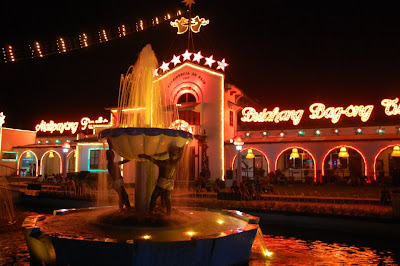
Pasko sa Bais 2011

Image
Central Visayas Christmas Capital
Image
Bais City Hall -Christmas Festival 2011

Teves Clan History Negros Oriental

A FAMILY TRADITION :  By : Sir Penn Tulabing.Larena,CPS, CPE MPA family Historian Vicente Anunsacion Teves  a sailor trader and a traveler. Ventured in the cultivation of sugarcane in 1852, married a Dumagueteña lady Rufina Villamil who bore him 14 children. Moving to Bais , he established Haciendas and became the first producer of muscovado sugar in 1867. The sweet family tradition continues to harvest a good service to the society and community (Philippine tatler May 08 issue p68 ). Don Anatalio Teves  the first son of the Teves couple is the builder of Bais, he builds most of the roads, train rails, light material wharf and established the Political family of the Negros Oriental, the “Villanueva Clan”. A graduate of Humanities from the Universidad de Salamanca in Spain later married to Dumaguteña Dona Aleja M. Pinili. They had three children, Anselma married to Hermenegildo Regis Villanueva Sr. produced Governors, Mayor...

120th years Negros Oriental

BRIEF HISTORY OF NEGROS ORIENTAL The province which is "boot shaped" on the map is on the eastern side of Negros Island, thus the name Negros Oriental which means East of Negros Island. It is composed of the mainland province and Apo Island which is a favorite of local and foreign divers. It has 3 congressional districts, 3 cities and 22 municipalities. Negros Oriental has 1,336.7 kilometers of scenic, clean and unspoiled beaches on one side, with beautiful mountains and rustic scenery on the other side. The province’s terrain consists of rolling hills, a few plateaus, and mountain ranges which for the most part are close to the narrow coastal trip. Kanlaon Volcano, the highest peak in the island of Negros at 2465 meter, dominates the northern end of the province. The whole eastern part of Negros Oriental has a climate characterized by no pronounced rainfall. The other half of the province has distinct wet and dry seasons. Negros Island was originally called " Buglas...

BAIS CITY PROFILE

Bais City is the largest producer of raw  sugar  in Negros Oriental. There are two  sugar mills  in the city. The Central Azucarera de Bais was established by Tabacalera of Spain in the early 1900s and is one of the oldest in the country. The other mill, URSUMCO (Universal Robina Sugar Milling Corporation) was formerly UPSUMCO (United Planters Milling Corporation) and constructed in the mid-'70s by Marubeni Corporation of Japan as a project of Ignacio Montenegro (also of Spanish roots). Geography There are two  bays  in the area, hence the name "Bais". The shoreline is mostly  mangroves , which are in danger of destruction due to the increasing population. The richness of marine life in the bays is because of these mangroves. Bais City's bays are widely known to have one of the most beautiful  coral reefs  in the area. The Pelarta river runs beside the city center. There is, however, a dispute that the name Bais was taken after...